


Food & Beverage
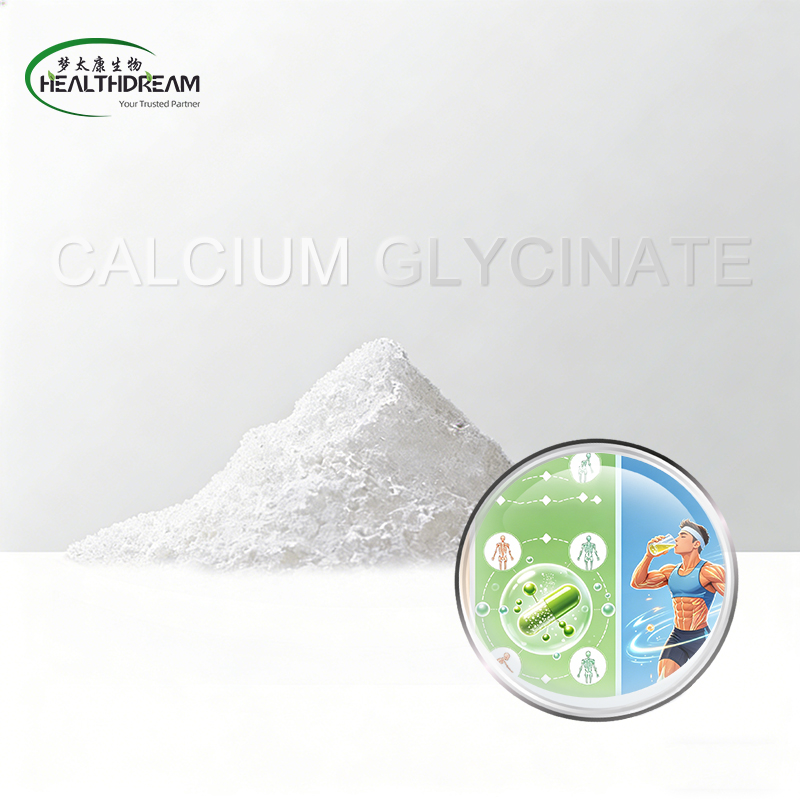
Calcium Glycinate
Calcium glycinate is a white crystalline substance formed by the combination of glycine and calcium, which is easily soluble in water and has stable chemical properties. Due to its good solubility and absorption, calcium glycinate is often used as a calci
Description

What is calcium glycinate?
Glycine calcium is a new generation of calcium nutrient fortifier in today's society, which is more easily absorbed by the human body than other calcium supplements.
Calcium glycinate, a glycine complex of calcium. White flake or granular powder, soluble in water, insoluble in ethanol, with a slightly sweet taste.
Calcium glycine can be fortified in dairy products (milk powder, milk, soybean milk, etc.) and solid drinks.
| Product name: | Calcium Glycinate |
| Molecular Formula: | C4H8CaN2O4 |
| CAS No: | 35947-07-0 |
| Appearance: | White flake or granular powder, soluble in water, insoluble in ethanol, slightly sweet taste. |
| Specifications: | Assay> 98.0% |
| Package: | 25kg/drum |
| Shelf life: | 2 years from date of production |
| Storage: | Keep container unopened in cool, dry place, away from light, oxygen. |
| Product classification: | Mineral supplements |
| Main uses: | Nutrient enrichment |

| Product name: | Calcium Glycinate |
| CAS No: | 35947-07-0 |
| Molecular Formula: | C4H8CaN2O4 |
| Molecular Weight: | 188.20 |
| EC Number: | 252-809-5 |
| Items | Specification |
| Apperance: | White Powder |
| Assay: | NLT 98.5 |
| Nitrogen (N) %: | 13.0-14.5 |
| Lead(Pb) %: | NMT 0.0010 |
| Arsenic (As) %: | NMT 0.0003 |
| Heavy metal(Pb) %: | NMT 0.002 |
| Loss on Drying%: | NMT 9.0 |
| PH value (1% solution): | 10.5~11.5 |
| Manufacturing technique: | Synthesis of food grade glycine |
| Packing: | 25KG cardboard drum |

1. Children's food and nutritional fortifiers
This product has high solubility and absorption rate. It can be directly used to strengthen children's food, health products, and sports drinks, and can also be made into flavored high calcium concentrate, widely used in the production of dairy products such as yogurt.
2. Health and Sports Nutrients
As an efficient source of calcium nutrition, its excellent bioavailability can effectively promote bone formation, making it an ideal raw material for producing dietary supplements and functional sports drinks.
3. Baking and fried foods
Adding an appropriate amount during the processing of pastries or fried foods can not only effectively increase the calcium content of the product, but also have antioxidant effects, prevent oil oxidation, and control excessive changes in food color, keeping the product fresh and beautiful.
4. Multi functional ingredients for food processing
In addition to serving as a nutritional fortifier, calcium glycinate also plays the role of a buffering and solidifying agent in food processing, stabilizing product systems, improving food texture, and having diverse application scenarios.

1. Fast dissolution, more clear solution
2.Weak astringency and friendly taste
3. Zinc organic acid, small irritation to gastrointestinal tract, high absorption rate
4. Good dispersion, strong stability and high applicability

Q1: What is calcium glycinate?
A: Calcium glycinate is composed of calcium that binds to glycine, and this strong binding force is called chelation. The pH value of calcium glycinate is stable (even in the acidic environment of the stomach). The stable bond between glycine molecules and calcium ions prevents dissociation.
Q2: What is the difference between calcium citrate and calcium glycinate?
A: The most easily absorbed form of calcium is called calcium bisglycinate. The solubility of this calcium is 205 times that of calcium citrate. In human studies, the absorption rate of calcium bisglycinate is 1.8 times better (180%) than calcium citrate and 21% better than calcium citrate malate.
Q3: How much calcium is contained in calcium glycinate?
A: Chelate glycine calcium form to improve bioavailability. Each serving of 1.5 milligrams provides 285 milligrams of elemental calcium (36% NRV). Calcium is essential for maintaining normal bones.
